
How To Play The Name Game: Rules and Tips

The Name Game is a fast, funny word-guessing party game where teams race the clock to identify names (people, characters, celebrities, fictional icons, historical figures, etc.) based on clues. It’s quick to learn, perfect for big groups, and works great for family gatherings, classrooms, camps, and team-building nights.
In this guide, you’ll learn how to play The Name Game, including the basic rules, step-by-step instructions, and a few easy tips to keep the energy high.
How Many People Do You Need to Play The Name Game?
TThe Name Game is a party game that works best with medium to large groups. You can play with as few as 6 people, but it gets more exciting as you add more players. We think the sweet spot is 10–20 participants, because there are more names in the bowl, faster turns, and more variety in the clues. It’s great for a group of friends hanging out at home, a family gathering during the holidays, or a casual game night when you want something easy to jump into. It also works really well for kids and teens at camp, classrooms, youth groups, and team-building events since everyone can contribute names and stay involved. If you have a huge crowd, just split into extra teams and rotate turns to keep the pacing quick and the guessing fair.
The Name Game Rules
-
Divide players into two equal teams.
-
Each player writes three slips of paper, each with one name (real or fictional).
-
Fold the slips and place them in a bowl (a hat or any container works).
-
The game has three rounds, each with different clue rules:
-
Describe – Talk freely without saying the name.
-
One Word – Use only one word as a clue.
-
Act It Out – Silent charades, no speaking.
-
-
Teams take turns with 1-minute timers.
-
A player may pass once per turn if a name is too hard.
-
After each round, tally the number of correct guesses.
-
The team with the most total points after 3 rounds wins!
-
(Optional) Add a bonus round for extra fun (see below).
How to Play The Name Game
You’ll need a few sim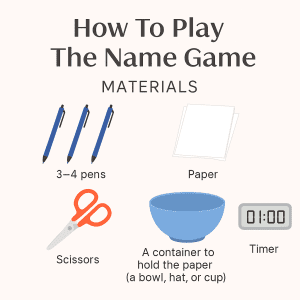 ple supplies, so start by gathering them in one place.
Gather the following materials:
- 3–4 pens
- Paper
- Scissors
- A container to hold the paper (a bowl, hat, or cup)
- A timer
Step 1: Populate the bowl
Cut the paper into strips and hand out three slips to every player. Each slip will have one name written on it.
Have everyone write names that are recognizable to the group. Inside jokes are fun, but if only one person knows the reference, that slip might stall the round.
Players fold their slips and place them into the bowl. Once all slips are inside, shake the bowl to mix them up.
Tip: Use a mix of easy + challenging names. Variety keeps the later rounds exciting.
Step 2: Play the “Describe” round
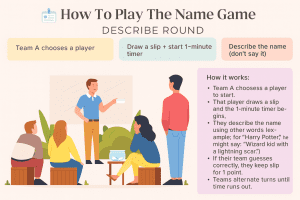
In this first round, players can talk freely to describe the name on their slip — but they cannot say the actual name, and no spelling or “sounds like” clues.
How it works:
-
Team A chooses a player to start.
-
That player draws a slip and the 1-minute timer begins.
-
They describe the name using other words (example: for “Harry Potter,” they might say: “Wizard kid with a lightning scar”).
-
If their team guesses correctly, they keep the slip for 1 point.
-
They keep drawing new slips until time runs out.
-
Teams alternate turns until the bowl is empty.
At the end of the round, tally the slips for each team, then return all slips to the bowl.
Step 3: Play the “One Word” round
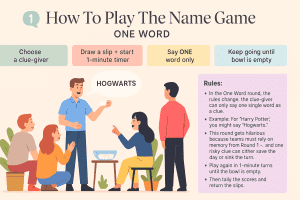
In the One Word round, the rules change:
-
The clue-giver can only say one single word as a clue.
Example: For “Harry Potter,” you might say “Hogwarts.”
This round gets hilarious because teams must rely on memory from Round 1 — and one risky clue can either save the day or sink the turn.
Play again in 1-minute turns until the bowl is empty. Then tally the scores and return the slips.
Step 4: Play the “Act It Out” round
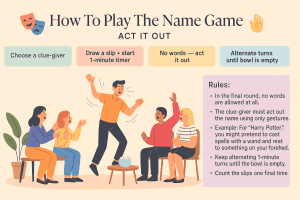
In the final round, no words are allowed at all.
-
The clue-giver must act out the name using only gestures.
Example: For “Harry Potter,” you might pretend to cast spells with a wand and react to something on your forehead.
Keep alternating 1-minute turns until the bowl is empty. Count the slips one final time.
Step 5: Bonus round (optional)
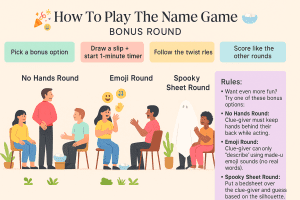
Want even more fun? Try one of these bonus options:
-
No Hands Round: Clue-giver must keep hands behind their back while acting.
-
Emoji Round: Clue-giver can only “describe” using made-up emoji sounds (no real words).
-
Spooky Sheet Round: Put a bedsheet over the clue-giver and guess based on the silhouette.
Name Ideas (So Nobody Gets Stuck)
If players aren’t sure what to write, here are safe categories that keep the game moving:
-
Movie and TV characters
-
Pop stars and celebrities
-
Athletes
-
Cartoon characters
-
Book characters
-
Historical figures
-
Famous brands/mascots (if your group likes it)
Tip: If kids are playing, pick a theme (Disney, superheroes, cartoons) so the names stay age-appropriate.
Play The Name Game: Bottom Line
The Name Game is easy to set up, quick to explain, and perfect for large groups. The repeat-slip format makes every round funnier than the last, because teams build momentum — and memory — as they go.
All you need is a bowl of names, a timer, and a group ready to be dramatic.

Leave a Reply
Want to join the discussion?Feel free to contribute!